Planning guide
Board Game Storage on a Budget
Budget storage should prove that the shelf you already own can carry the real boxes before money goes toward more organizers. Check support span, false capacity, and label clarity so low-cost storage improves access instead of hiding another mixed pile.
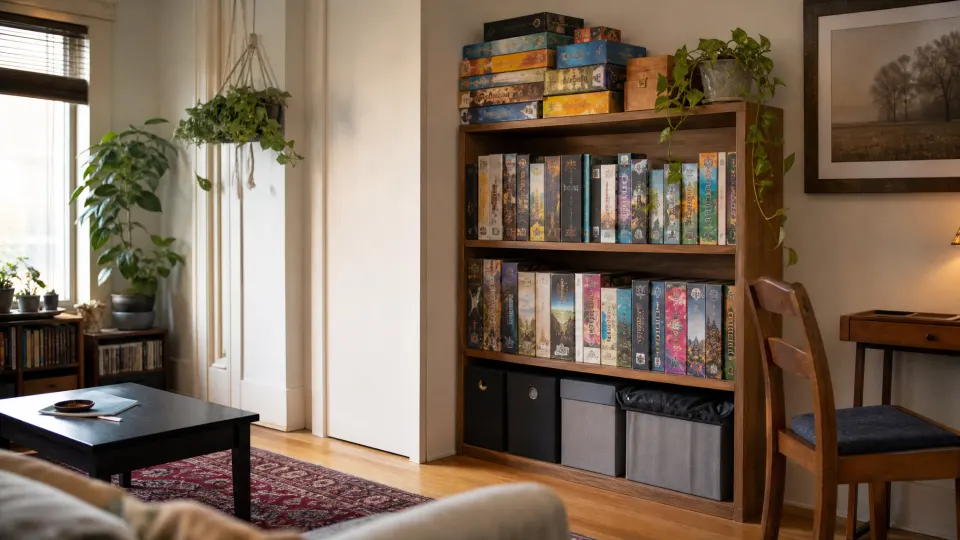
Spend first on fit, support, and labels
A low-cost shelf only saves money if it holds the real boxes without bowing or blocking access. Check the largest footprint, support span, and front overhang before buying bins or another flat-pack unit. Labels and simple bookends often fix the actual problem for less than new furniture.
Make reused furniture serve the active games first
If the budget plan starts with furniture you already own, give the easiest shelf to games that move often. Keep bargain-bin overflow lighter, lower, and plainly labeled so it does not hide the collection. The cheapest setup is the one that avoids a second purchase.
Spend on supports before another organizer
Budget storage should start with the shelf you already own, the support span, and the labels that make capacity honest. Put reused furniture in the most convenient living-room grab area only if it can hold the real boxes without bowing or snagging. A cheap closed bin can handle calm overflow, but it needs a front label and a weight limit before it becomes false capacity.
Use labels to make cheap capacity honest
Cheap shelves and bins can look roomy until every category mixes together. Label one area for active games, one for small boxes, one for expansions, and one for outgoing titles. When a label has no room left, the next step is a decision, not another unlabeled tote.
Do not let false capacity damage boxes
Overloaded bargain shelves can bow, and deep tubs can crush small games under heavier boxes. Keep dense games low, avoid floor piles near damp entries, and stop loading a shelf when boxes start rubbing on the supports or trim.
Quick checklist for this storage plan
- Measure cheap shelves and false capacity before choosing the living-room budget shelf
- Keep reused-furniture options where players can judge access quickly
- Keep bargain shelves lightly loaded until supports and box overhang are proven
- Leave a practical pull gap before a cheap shelf looks full
- Spend first on measurements, supports, and labels.
Board game fit check
Use this quick shelf check before buying bins, cabinets, or cube units for a small home.
- Primary measurement: shelf support, false capacity, box overhang, and label access
- Clearance check: shelf support, false capacity, label access, and box overhang
- Access test: pull a frequently played game from the budget shelf without flex or snagging
- Calculator follow-up: measure first so the budget goes to supports instead of replacement furniture
For a measured plan, use the board game shelf-fit calculator. You can also compare options in the shelf depth guide.