Planning guide
Board Game Storage Ideas for Small Homes
In a small home, the winning storage plan starts with the walking lane, not the furniture catalog. Keep the games that leave the shelf most often near the table route, then use sofa clearance and one open rotation slot to keep the room usable.
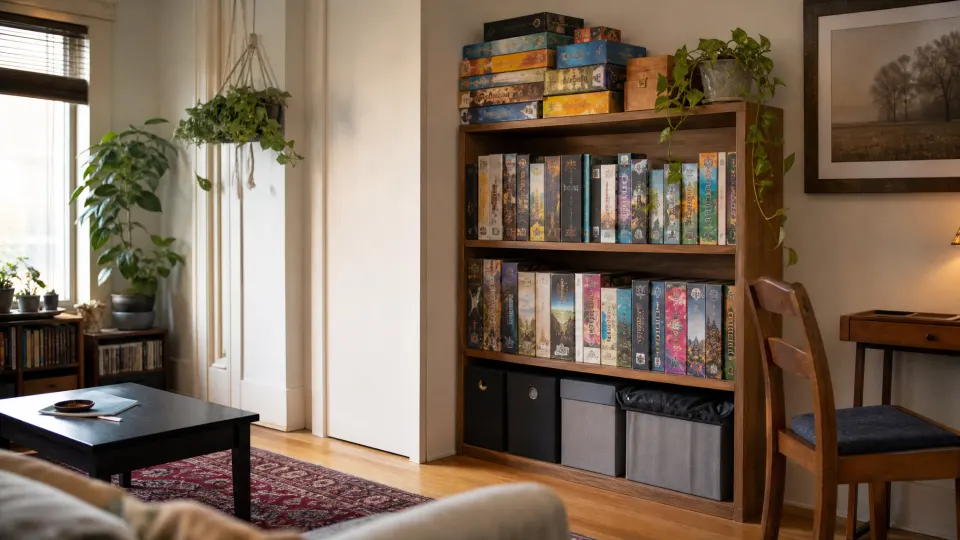
Start with the path from shelf to table
In a small home, the useful shelf is the one that can be reached while the room is in its normal state. Note the widest box, the sofa-side pull gap, and the route to the table before choosing storage. A narrow shelf near the play area can beat a larger unit that blocks the walkway every time a big box comes out.
Put weekly games in the easiest pull zone
Treat the front, hand-height shelf as the active rotation: weekly family games, current campaign boxes, and the party game that actually leaves the room. Lighter fillers and rarely used expansions can move to the side or top as long as their labels stay readable. The point is a shelf that resets quickly after play, not a wall of boxes packed to the edges.
Mock up the shelf while the room is in use
Before buying a new unit, mark the living-room shelf footprint with tape or empty boxes and walk the normal route from sofa to table. Weekly family games and current strategy titles deserve the hand-height openings; party games and overflow can sit farther away if the labels are readable during cleanup. Keep one empty slot in the active row so a new purchase does not immediately become a floor pile.
Use small zones with visible limits
Name one row for family games, one tray for card boxes, one spot for expansions, and one small space for games waiting to leave. Those limits make new purchases easier to judge because overflow has an obvious cost. A simple spine tag or shelf code is enough if it helps the next cleanup land in the same place.
Watch the corners, floor, and leaning rows
Small rooms punish tight storage: corners scrape trim, loose-lid boxes slide, and floor piles get kicked. Keep dense strategy boxes low, leave finger space at the shelf face, and move leaning rows into bookends or flat stacks before lids start taking the strain.
Small-home scenario: one living room shelf
If the table, sofa, and shelf share one room, reserve the easiest shelf opening for the five to eight games that leave the shelf every month. Put party games and card boxes in a labeled side bin, keep heavy strategy boxes low, and send oversized titles to a separate low zone instead of letting them consume the prime row.
Small-home storage decision framework
| Factor | Choose | Avoid |
|---|---|---|
| Weekly play | Open shelf at hand height | Closed bin behind furniture |
| Oversized boxes | Low separate zone | Tight cube with scraped corners |
| Mixed small games | Labeled tray or shallow bin | Loose pile behind square boxes |
Quick checklist for this storage plan
- Measure sofa clearance before choosing the living room shelf
- Keep weekly family and strategy titles between waist and shoulder height
- Store the heaviest strategy boxes low so small shelves stay stable
- Confirm the sofa-side pull gap before the shelf is full
- Leave one open slot for rotation before calling the shelf full.
Board game fit check
Use this quick shelf check before buying bins, cabinets, or cube units for a small home.
- Primary measurement: sofa clearance, largest box footprint, and the carry route to the table
- Clearance check: sofa lane, shelf face, and the hand space needed for the largest box
- Access test: pull a weekly game while the sofa path and rotation slot stay clear
- Calculator follow-up: compare the shelf-fit result against the sofa path and table route
For a measured plan, use the board game shelf-fit calculator. You can also compare options in the shelf depth guide.