Shelves guide
Vertical Board Game Storage
Make upright rows the first filter for storage choices. Vertical storage depends on tight lids, row support, usable shelf height, and enough side room to pull one box without toppling the next. Check leaning rows and lid slide, then place the most-played games where retrieval stays simple.
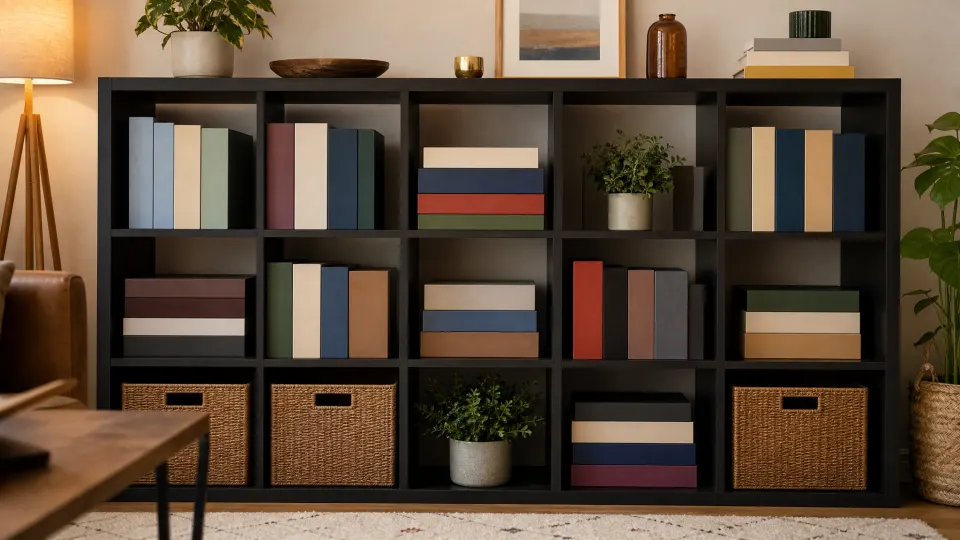
Check upright clearance and row support
Measure upright height, shelf depth, and the support at both ends of the row. Vertical storage works only when the box can stand without lid slide, side scrape, or a leaning chain reaction. Use the tallest tight-lid game as the test box before assigning a whole row.
Keep only stable boxes upright
Upright rows are best for tight lids, supported inserts, and boxes that can be pulled like books. Move loose-lid games, heavy campaign boxes, and fragile inserts to flat storage. If removing one game makes the row collapse, the row needs a bookend or fewer boxes.
Reserve vertical rows for boxes that behave upright
Tight-lid games and sturdy square boxes are better vertical candidates than loose-lid games with heavy inserts. Put those reliable boxes near the front of the office shelf and use bookends before a row starts leaning into the gap. Titles that slide, spill, or need careful setup should move flat or receive a clear label in a slower zone.
Use row labels for scan speed
Vertical storage helps most when players can scan the row quickly. Label sections by play style, owner, campaign, or player count so the row does not become a single alphabetized wall that is hard to reset. Leave a small gap for returning a game without shoving the row sideways.
Stop leaning before it damages lids
Leaning rows put pressure on lid edges and can slide loose components inside the box. Add a bookend while the row is still straight, keep the heaviest upright boxes low, and move any game that twists during retrieval back to flat storage.
Vertical scenario: readable row with mixed lids
Use vertical storage for boxes that behave like books: tight lids, sturdy inserts, and enough side support. The moment a game slides, leans, or spills components when upright, move it to a flat stack and keep the vertical row for games that can be removed one-handed.
Vertical storage suitability
| Factor | Choose | Avoid |
|---|---|---|
| Tight lid and supported insert | Vertical row | Burying it under flat stacks |
| Loose lid or heavy components | Horizontal stack | Upright row that shifts contents |
| Long readable spines | Bookend-supported shelf | Leaning row with no return gap |
Quick checklist for this storage plan
- Measure leaning rows and lid slide before choosing the office-corner shelf
- Give stable vertical rows the easiest scan line
- Keep loose-lid or extra-heavy boxes out of vertical rows
- Leave room for a straight pull before adding bookends
- Use bookends before a vertical row starts bowing.
Board game fit check
Use this quick shelf check before buying bins, cabinets, or cube units for a small home.
- Primary measurement: upright height, lid tightness, shelf depth, and row support
- Clearance check: shelf height, row lean, and lid security during retrieval
- Access test: remove one upright game without the neighboring row leaning into the gap
- Calculator follow-up: confirm height and depth before committing boxes to upright storage
For a measured plan, use the board game shelf-fit calculator. You can also compare options in the shelf depth guide.