Furniture guide
Board Game Storage Shelves
Board game storage shelves work best when open shelf planning sets the first constraint, then capacity is judged by what stays easy to retrieve. Let visibility, box weight, and movement frequency drive the shelf choice. Rank the shelf by shelf bowing and row weight, then give prime positions to the boxes that benefit most.
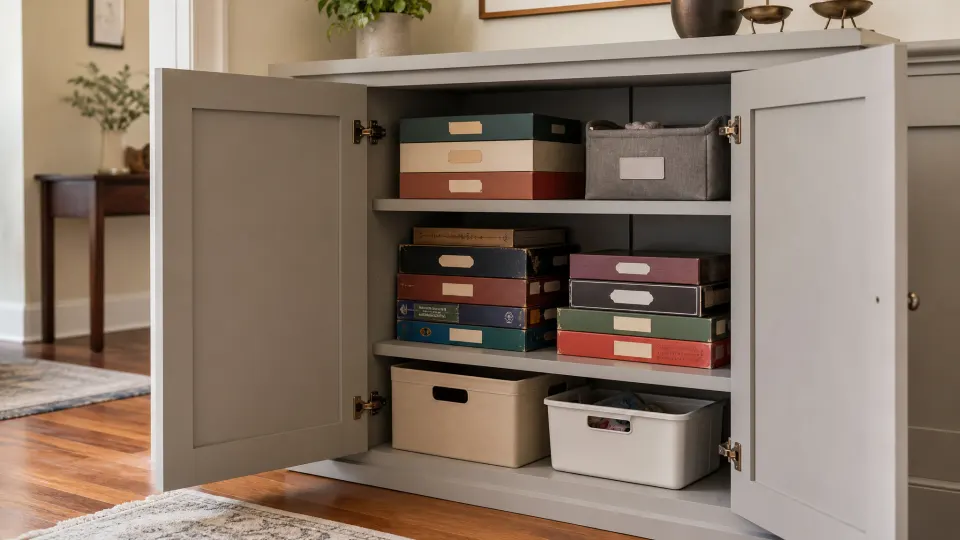
Plan shelf spans around weight and visibility
Open shelves need a different check than cabinets: span length, support position, row weight, and the room to stand in front of the shelf. A long shelf can fit many boxes and still bow in the middle. Test the heaviest row near the supports before filling every visible inch.
Let open shelves do the browsing work
Use open rows for games people choose by scanning spines: family favorites, two-player games, and current strategy titles. Closed furniture can hold overflow nearby, but it needs plain labels and a reset habit so the visible shelf remains useful.
Load the heaviest row near the supports
Open shelves look generous until a long span starts to bow. Put dense strategy boxes low and close to supports, then keep spine-visible family and two-player games where the row is easy to scan. Overflow can move behind doors, but only with labels that explain what left the open shelf and why.
Label the overflow that leaves the open shelf
When a game moves behind a door or into a bin, give it a category label before it disappears from view. Short labels such as overflow party, campaign extras, or kids backups help another player find the right box without searching the whole room.
Watch span, bowing, and front pull room
Keep heavy strategy games close to shelf supports instead of the center of a long span. Leave the row shallow enough to browse and the front clear enough for a clean pull. If a shelf starts to bow, reduce the row before adding more boxes.
Quick checklist for this storage plan
- Measure shelf bowing and row weight before choosing the dining-room shelf
- Put spine-visible libraries on the row that is easiest to scan
- Keep the heaviest row close to the supports, not at the middle of a long span
- Leave a pull gap at the front so heavy rows do not fight the shelf
- Keep the heaviest row low and near the supports.
Board game fit check
Use this quick shelf check before buying bins, cabinets, or cube units for a small home.
- Primary measurement: shelf span, loaded row weight, bowing risk, and front pull gap
- Clearance check: shelf span, bowing risk, row weight, and front hand space
- Access test: remove a spine-visible game while the loaded shelf stays level
- Calculator follow-up: pair box measurements with shelf-load and span checks
For a measured plan, use the board game shelf-fit calculator. You can also compare options in the shelf depth guide.