Furniture guide
Board Game Storage Cabinet Guide
Plan around hidden cabinet storage before choosing a cabinet, bin, or shelf. Choose furniture by visibility, loaded weight, and how often the games need to move. Check hinges, lips, and door swing, then put the games used most often in the easiest reachable zone.
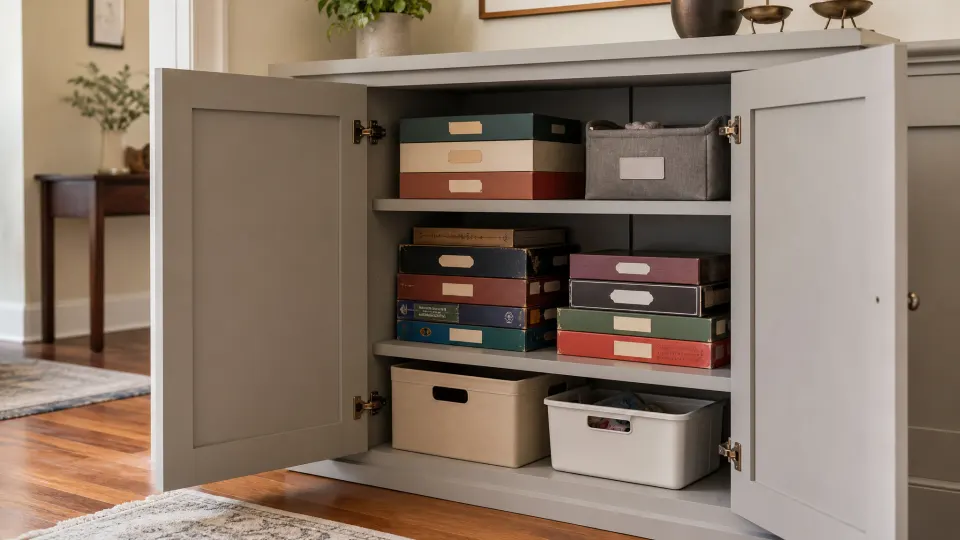
Check cabinet hardware and interior openings
Measure the interior opening with the cabinet door fully open, then check the hinge side, front lip, and shelf-pin positions. A cabinet can look deep enough while the hardware steals the exit path. Record the largest box that clears the hinge and the weight each adjustable shelf can reasonably carry.
Use cabinet doors for calm storage, not mystery storage
Cabinets work well for slower categories, adult-only games, or visually quiet rooms when the labels remain easy to find. Keep the most-played titles near the front or on an open shelf nearby. If opening three doors is required to find a game, the cabinet needs clearer zones.
Plan around the hinge side and door lip
Cabinets hide clutter, but hinges, lips, and handles shrink the real opening. Place frequently chosen games where their spines can be identified as soon as the door opens, and keep oversized boxes away from the hinge side unless they clear cleanly. Quieter cabinet zones need shelf-edge tags so closed doors do not turn them into storage nobody checks.
Put the label where the door hides the spine
Use a shelf-edge tag, door-back list, or bin label for any game that cannot be identified at a glance. The label should name the category in plain language, such as heavy strategy, party games, or expansions, so the cabinet stays searchable.
Keep dense boxes away from weak hardware
Adjustable pins, long spans, and hinge-side obstructions should decide where the heavy games go. Put dense boxes low, keep oversized games away from the door lip, and leave enough hand room that corners clear the frame on the way out.
Quick checklist for this storage plan
- Measure hinges, lips, and door swing before choosing the hallway cabinet
- Put calmer-room collections behind doors only when labels stay visible
- Keep dense boxes away from weak adjustable pins and high cabinet shelves
- Keep the hinge side clear enough that boxes do not scrape on exit
- Label hidden shelves so closed doors do not hide forgotten games.
Board game fit check
Use this quick shelf check before buying bins, cabinets, or cube units for a small home.
- Primary measurement: interior opening, hinge arc, shelf-pin clearance, and door lip
- Clearance check: hinge arc, shelf pins, door lips, and hand pull space
- Access test: open the door fully and remove a large game without scraping cabinet hardware
- Calculator follow-up: compare measured box fit with the cabinet hardware clearance
For a measured plan, use the board game shelf-fit calculator. You can also compare options in the shelf depth guide.