Planning guide
Board Game Storage for Small Spaces
Tight rooms need storage that works while the bed, desk, chair, and door are already in the way. Check the door swing, nightstand gap, and deepest box pull before assigning the most reachable shelf frontage to active games.
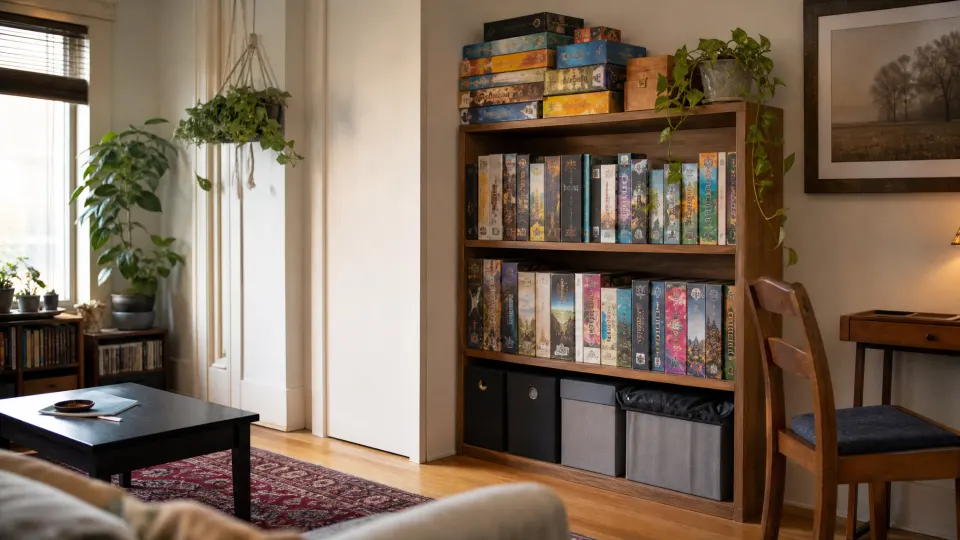
Map the tight-room conflicts first
A bedroom, den, or office corner usually fails at the conflict points: door swing, nightstand gap, desk chair path, or the hand space needed for the deepest box. Measure those pinch points with the room set up normally. Then choose the shelf that lets the largest game move without rearranging the furniture.
Give scarce shelf frontage to games in rotation
The best frontage should hold the games that are pulled most often or need the most careful handling. Occasional party games, duplicate boxes, and quiet expansions can move to less convenient shelves if they remain findable. In a tight room, an easy reset matters more than showing every box face.
Treat the tight corner as the real limit
A bedroom cabinet may look large until the nightstand, door swing, and bed frame all compete for the same pull space. Give mixed-size boxes the shelf that can be reached without twisting them past furniture. Hidden overflow needs category labels and a visible boundary, otherwise the small-space solution becomes one active shelf plus a forgotten second collection.
Keep overflow from becoming a second collection
Separate active games, occasional games, card boxes, and expansions so overflow has a defined home. If a zone fills, decide whether a game rotates out before adding another box. This keeps a small cabinet from turning into one readable shelf plus one hidden backlog.
Avoid the damage caused by tight retrieval
Boxes get worn when they have to twist past bed frames, cabinet lips, or overfilled rows. Keep heavy titles below awkward lift height, leave a clear pull gap, and store loose-lid games flat when vertical rows make them slide. A little empty space is cheaper than crushed corners.
Small-space scenario: bedroom plus desk corner
When the shelf sits near a bed or office chair, the deciding measurement is usually the pull path, not the wall width. Store frequent games where the chair does not need to move, put awkward boxes below desk height, and keep one visible overflow limit so the room does not split into several hidden piles.
Tight-room choice table
| Factor | Choose | Avoid |
|---|---|---|
| Door or chair swing | Narrow open shelf | Deep cabinet that needs a full door arc |
| Games used monthly | Front-facing active row | Under-bed overflow as primary storage |
| Mixed expansions | One labeled bin with a cap | Several unlabeled partial stacks |
Quick checklist for this storage plan
- Measure door swing and nightstand clearance before choosing the bedroom cabinet
- Give mixed-size boxes a hand-height spot that avoids the nightstand swing
- Keep tall or heavy boxes below the level where nightstand clearance becomes awkward
- Leave enough cabinet frontage for a clean pull and reset
- Keep overflow visible enough that it does not become a second collection.
Board game fit check
Use this quick shelf check before buying bins, cabinets, or cube units for a small home.
- Primary measurement: door swing, nightstand gap, shelf depth, and largest box side
- Clearance check: cabinet door swing, nightstand gap, and the largest-box handhold
- Access test: retrieve a mixed-size game without moving bedside furniture or overflow
- Calculator follow-up: check the measured fit against the small-room route
For a measured plan, use the board game shelf-fit calculator. You can also compare options in the shelf depth guide.