Apartments guide
Small Apartment Board Game Storage
Apartment storage starts with the parts of the room you cannot change: door swings, lease limits, shared paths, and the furniture that has to leave cleanly later. Give daily games a visible freestanding home, then use closets only for boxes that can wait behind a clear label.
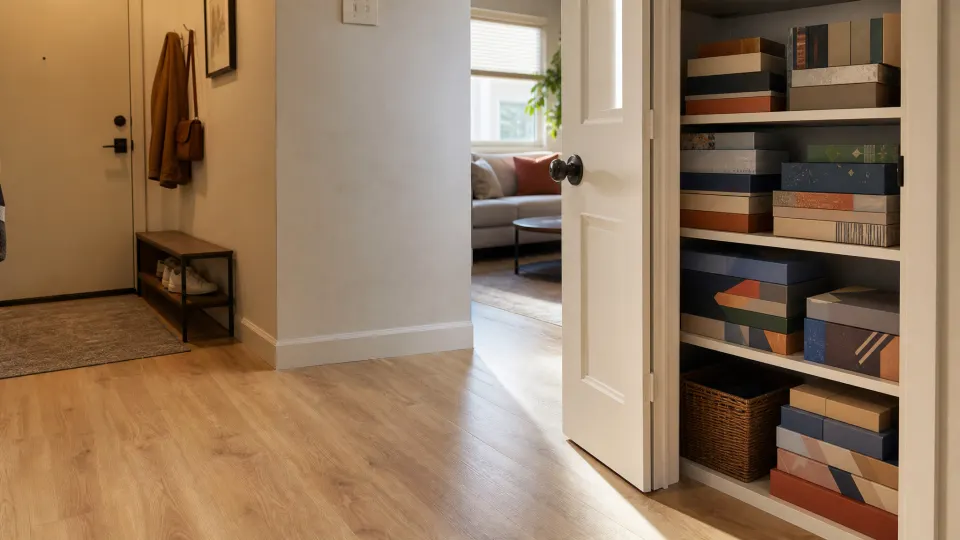
Check apartment clearances before buying storage
Walk the storage route before choosing a unit: entry door, closet swing, radiator gap, and the narrowest turn between the shelf and table. In an apartment, a shelf that fits on paper can still block the path people use every day. Note the largest box and the door arc together so the storage piece earns its floor space before it arrives.
Keep renter storage movable and reachable
Place frequent games in freestanding storage that one person can empty, move, and reset without blocking the lease-safe walkway. Heavy games should stay low in units that do not need permanent mounting. Overflow belongs in labeled bins only when those bins can move on lease renewal day without unpacking the whole closet.
Keep roommate games out of the closet trap
Apartment closets often fail because the shared games land behind coats, vacuum parts, or seasonal bins. Put roommate favorites near the closet edge or on a freestanding shelf that clears the entry path, then use closed bins only for slower titles with front-facing labels. Any storage piece should be able to leave on moving day without patching walls or unpacking half the apartment.
Label temporary storage before moving day
Renter-friendly storage often uses closed bins, closets, and furniture that changes rooms, so labels need to survive a move. Put the game category on the bin face and keep a short phone note for anything hidden behind household storage. Mark loaners and party games separately so they can leave without digging through packed boxes.
Avoid storage that creates lease damage
Choose freestanding pieces, felt pads, and low shelves before drilling into walls or crowding closet hardware. Keep boxes away from damp entry floors and sharp door tracks, and test whether the full unit can be moved without scraping trim. The best renter setup protects the games and the deposit at the same time.
Apartment scenario: shared entry and closet
For a shared apartment, keep roommate favorites out of the coat-closet back row. A movable cube, low cabinet, or labeled front closet shelf works better because one person can pull a game without blocking the entry or unpacking household storage.
Apartment storage tradeoffs
| Factor | Choose | Avoid |
|---|---|---|
| Lease-safe setup | Freestanding furniture with pads | Permanent wall anchors unless required for safety |
| Shared access | Visible labels near the door side | Games behind seasonal bins |
| Moving day | Zones that can be packed by category | Mixed shelves with no inventory note |
Quick checklist for this storage plan
- Measure entry and closet-door clearance before choosing the apartment closet
- Put roommate-shared games where they can be removed without blocking the entry
- Put dense games on lower shelves so freestanding storage stays renter-friendly
- Keep the closet pull area open enough for one person to retrieve a game
- Favor furniture that can move on lease renewal day.
Board game fit check
Use this quick shelf check before buying bins, cabinets, or cube units for a small home.
- Primary measurement: entry clearance, closet-door swing, and the largest box footprint
- Clearance check: closet door swing, entry path, and room to pull the largest box
- Access test: remove a shared game without blocking the apartment entry or emptying the closet
- Calculator follow-up: use the shelf-fit number to choose a renter-safe closet or freestanding piece
For a measured plan, use the board game shelf-fit calculator. You can also compare options in the shelf depth guide.