Furniture guide
Modular Board Game Storage
Make modular furniture the first filter for storage choices. Pick the furniture after you know which boxes must be seen, lifted, or moved often. Check module seams and door clearance, then place the most-played games where retrieval stays simple.
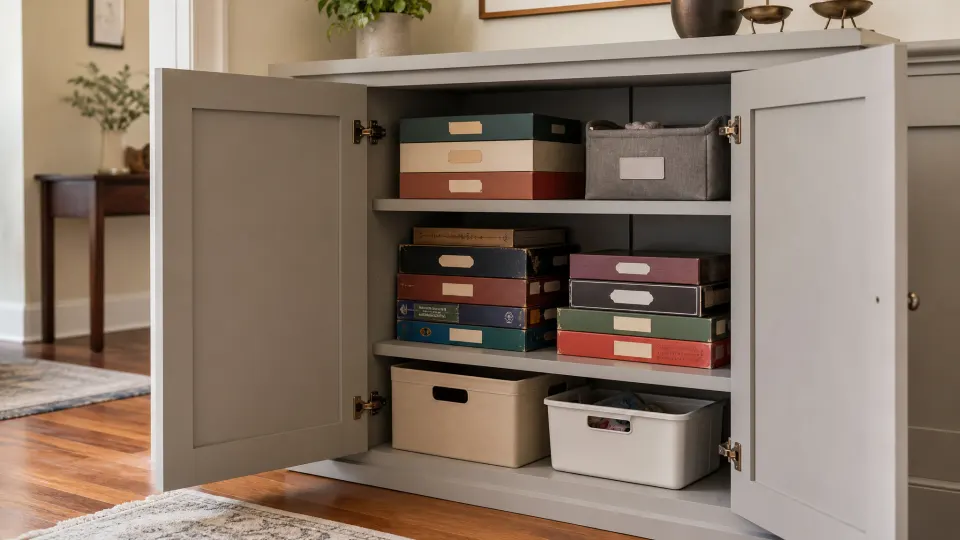
Plan modules around categories that change
Map each module by usable opening, door swing, seam position, and category growth. Modular systems work best when a section can change jobs without disturbing the whole wall. Check where heavy boxes land before a weak cube or shelf span becomes permanent.
Give each module a job that can change
Assign modules to active games, protected boxes, travel kits, overflow, or outgoing titles. When a category grows, move the module boundary rather than mixing every cube together. The advantage of modular storage is easy reassignment, not just more squares on the wall.
Plan modules around categories, not empty wall space
Modular storage is tempting to expand before the collection has clear jobs. Assign modules for current rotation, expansions, card games, protected boxes, and overflow before filling a bedroom wall. Games people reach for should stay exposed, while protected or slower categories need plain labels that survive future module changes.
Keep closed modules searchable
Doors and bins can hide a changing category too well. Put a short label on each closed module and keep any inventory note close to the storage. If a category moves, update the label at the same time so the system does not drift.
Leave room at seams, doors, and weak compartments
Distribute dense games low and away from weak adjustable sections. Keep module seams and door arcs clear enough that boxes do not scrape during cleanup. A flexible system stops being flexible when every cube is packed tight.
Quick checklist for this storage plan
- Measure module seams and door clearance before choosing the bedroom module wall
- Keep flexible collections where modules can change without rebuilding the room
- Keep dense modules low and leave changing categories where modules can be reworked
- Leave clearance at module seams, doors, and adjustable shelves
- Plan modules around categories, not around empty wall space.
Board game fit check
Use this quick shelf check before buying bins, cabinets, or cube units for a small home.
- Primary measurement: module seam, door swing, shelf-pin clearance, and category growth
- Clearance check: module seam, door swing, shelf pins, and category growth
- Access test: move one category between modules without breaking the rest of the layout
- Calculator follow-up: use fit results to size modules by category, not by empty wall
For a measured plan, use the board game shelf-fit calculator. You can also compare options in the shelf depth guide.