Shelves guide
Kallax Board Game Storage Guide
This Kallax board game storage guide starts by checking cube openings and box orientation against the way games actually leave the shelf. Kallax dimensions only help after inserts, backing, doors, and finger pull are accounted for. Let cube depth and the largest square boxes decide which games get the easiest daily access.
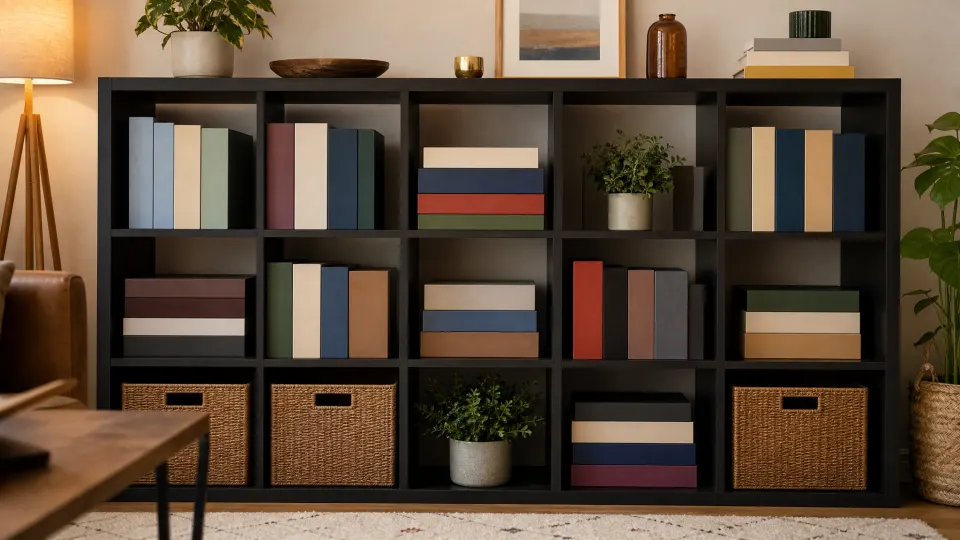
Measure the usable cube, not the outside unit
Measure the actual Kallax cube opening after any inserts, doors, baskets, or backing are considered. Square hobby boxes need more than nominal cube depth; they also need a front grip and enough side space to avoid scraping. Record the usable opening and decide which cubes are for upright rows, flat stacks, or overflow before filling the unit.
Assign each cube by box behavior
Use upright rows for tight-lid games that scan well from the spine. Use flat stacks for heavy games, loose lids, or inserts that let components shift. Keep oversized square boxes low enough that the cube can still be loaded and reset by one person.
Assign cubes by the boxes that strain them
Use the largest square hobby boxes to decide which cubes are truly usable, because a snug cube with no finger pull behaves more like a drawer than a shelf. Regular plays belong in the easiest openings, while inserts, doors, or bins should be reserved for slower titles with labels on the outside. One oversized box should clear the side panels cleanly before the rest of that cube is filled.
Use cube labels that survive cleanup
A cube label can be as simple as family, heavy strategy, two-player, card games, or expansions. Label the cube edge, not just the bin hidden inside it, so another player can return a game after cleanup. Leave part of one cube open for new arrivals or games waiting to be refiled.
Prevent cube-edge corner wear
Do not treat a barely fitting cube as a successful fit. Repeated side-panel scraping wears corners, and leaning upright rows can bow neighboring boxes. Add finger space, bookends, or a flat-stack assignment before the cube becomes a tight drawer.
Kallax scenario: standard cube with one deluxe box
A standard square game may fit a cube cleanly while a deluxe or campaign box turns the same cube into a tight drawer. Test the largest box first, then decide whether that cube is for upright rows, flat stacks, labeled bins, or an intentionally empty pull gap.
Kallax cube assignment table
| Factor | Choose | Avoid |
|---|---|---|
| Tight-lid square boxes | Vertical row with bookend | Overfilled row with no side gap |
| Loose lids or heavy inserts | Short horizontal stack | Upright storage that lets components slide |
| Oversized box | Separate low shelf or cabinet | Cube opening that scrapes both sides |
Quick checklist for this storage plan
- Measure cube depth and finger pull before choosing the cube shelf
- Reserve the cleanest cube openings for square hobby boxes
- Keep oversized square boxes low enough that cube corners do not take the weight
- Keep a side gap so boxes slide out without corner scrape
- Test one oversized box before loading every cube.
Board game fit check
Use this quick shelf check before buying bins, cabinets, or cube units for a small home.
- Primary measurement: usable cube opening, backing depth, and box orientation
- Clearance check: cube opening, backing depth, and finger room on both sides
- Access test: slide an oversized box out of the cube without scraping both side panels
- Calculator follow-up: verify the cube dimensions before assigning vertical or flat rows
For a measured plan, use the board game shelf-fit calculator. You can also compare options in the shelf depth guide.